
Home » Uncategorized (Page 5)
Category Archives: Uncategorized
Statement from Afifa Azam : If Justice is done Ghulam Azam will be proven not guilty
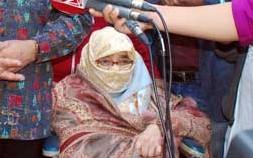
Wife of former Jamaat e Islami Ameer, Professor Gulam Azam, Mrs Afifa Azam said in a statement yesterday:
The Government of Awami League and its partners designed this International Crimes Tribunal (ICT) as a tool to persist in power forever. After proceeding through its different chapters, people are distress-fully waiting for the judgment chapter of this case.
Some flashback regarding this matter: India and Pakistan was divided at 1947. The non-Muslims leaders at that time were heavily opposed to creation of a separate Muslim state, and they continue to conspire against it. The Bengali people were subject to injustice, inequality, resistance and prejudice, which made them revolt in 1971.
Those who were already opposed to the conspiracy of India against Pakistan could not back this claim of independence due to three reasons. 1) India is historically against Muslim settlement. 2) India wanted to turn the west part i.e. Bangladesh now, into a subordinate state of theirs. 3) India intended to use Bangladesh as their economic market.
The past 42 years of independence has proven that those concerns were 100% true.
Post-independence, 195 army personnel of Pakistan were listed as war criminals. But after a tripartite agreement at Simla between Bangladesh-Pakistan-India on July 2 1972, those criminals were pardoned. Even the law for punishing local perpetrators, otherwise known as the ‘Dalal Law’, was also eliminated.
Today, after 4 decades, only for political purposes, “War criminal” issue has been dramatized in order to create instability and chaos. Under the leadership of Ghulam Azam, Awami League worked with Jamaat-e-Islami for about three decades. They even begged for their coalition by offering two ministerial positions and seven female members of parliament seats in the 90s. The president nominee personally met Ghulam Azam for blessing. During 90s the Awami League along with Jamaat protested demanding Caretaker Government. They were never blamed as War Criminals then. But now after their massive loss in the 2001 elections, in which Jamaat formed a coalition with BNP, Awami League is using the 1971 issue for pure political revenge to annihilate their opposition, Jamaat.
They amended the 1973 law against the army of Pakistan, transforming it into the International Crimes Tribunal (ICT), where apart from its name, nothing is international. Many international organizations have criticized this tribunal. The “Skypegate” scandal where the chairman of the ICT, the prosecution, an expatriate lawyer and government minister were exposed as working in collusion has demeaned Bangladesh’s Judiciary worldwide.
The Shahbag drama added a new dimension to this injustice. Instead of taking witnesses and facts into account, the Prime Minister herself urged the court to take this so-called new generation’s hopes and wishes into account. Their aim is one: “we want hanging” (rather than justice). The public does not accept this tribunal to be clean, fair and acceptable. People’s conscious cannot be deceived for long.
On 17th April the Ghulam Azam case had its final hearing. We strongly believe, if the witnesses and proofs are taken into consideration, he will come out clean and with full dignity. We hope that, the respected judges will keep themselves above all influence, feelings and wishes, and deliver a judgment which will be fair and just.
Analysis of Professor Ghulam Azam’s case

Professor Ghulam Azam was not a lighthouse of a criminal campaign; rather he worked as a lighthouse for the Islamic and democratic movement in Bangladesh. The prosecution has utterly failed to produce any evidence required for conviction and punishment in a criminal proceeding. A judgment cannot be based on emotion but on the evidence. The case against Prof. Ghulam Azam on the charge of his alleged involvement in crimes against humanity is full of emotion and concocted stories but what it is missing is evidence.

Let’s now analyze the case of Prof Ghulam Azam.
Prof Ghulam Azam has been charged with the murder of police inspector Miru Mia on the basis of an alleged letter of Prof Ghulam Azam. However, the alleged letter has not been recorded as evidence in the Tribunal. None amongst the collector, conveyer or bearer or the addressee of the alleged letter has been called as witness to the Tribunal. This means that the prosecution has not been able to present any evidence. They have merely concocted baseless stories.
It is stated that Prof Ghulam Azam conspired with Tikka Khan. However, no witness has confirmed this. No documents have been submitted in support of this. A political party chief can surely meet an army general of the country at a discussion table. Nobody can deny that Sheikh Mujib also held meetings with Bhutto. What matters here is that no evidence was produced or no witness was brought in the Tribunal to prove what Prof Ghulam Azam discussed with Tikka Khan that should constitute conspiracy.
Prof Ghulam Azam has been charged with the murder of 38 freedom fighters in Brahminbaria jail at his written instruction. However, no evidence has been presented in the Tribunal as to who was the messenger of his written instruction, to whom it was addressed, what was written in that letter. Furthermore, no existence of any such letter has been established. Superior or command responsibility only applies to the military and not to civilians.
The Defence Counsel had presented a list of 2,939 witnesses in defence of Prof Azam. The prosecution protested the list, at which the court told the defence to present a fresh list of no more than 12 witnesses. No such arbitrary limit was placed on the prosecution, who presented 16 witnesses – 4 more than the defence. It is also interesting that with no limit placed on them, the prosecution was only able to present 16 witnesses against Prof Azam’s 2,939. It is clear how partial and unfair this court is in openly pandering to the prosecution and hindering the defence. Later the court forced the defence to conclude Prof Azam’s defence on a single witness.
None of the documents of the prosecution was prepared by the investigating officer, Matiur Rahman, but were created by Dr Ahmed Ziauddin. Dr Ahmed Ziauddin created them in connivance with the prosecution and submitted to the Tribunal in the name of the prosecution. This is fraud. Whatever Justice Nizamul Haque has issued in the Tribunal including the charge sheet and orders, nothing is his own deliberation. Everything is prepared by Dr Ahmed Ziauddin from abroad. Nevertheless, Justice Nizamul Haque later passed those as his own deliberation. By this he has committed fraud and misconduct. As such this trial is entirely discredited.
Five drafts of charge sheet against Prof Ghulam Azam came from Belgium resident Dr Ahmed Ziauddin. Furthermore, it is Ziauddin who from Belgium determined as to whom should be selected as witnesses and what statements should be solicited from the witnesses etc. On 12/05/2012, from Belgium Dr Ahmed Ziauddin sent the last draft of the charge sheet against Prof Ghulam Azam via email to Justice Nizamul Haque. Justice Nizamul Haque copied the same draft in verbatim and issued the charge sheet order against Prof. Ghulam Azam on 13/05/2012.
As such this tribunal has been heavily manipulated from abroad by a person with no official role in the court and whose role in the court was not made known and kept concealed until it was exposed by the Skypegate scandal. Following the scandal, the tribunal Chairman, Justice Nizamul Haque resigned, yet these fraudulent activities were not rejected and the trial continued as if nothing happened. Under such circumstances, the trial of Ghulam Azam cannot be considered credible or fair.
Cases concluded in Ghulam Azam’s case
The arguments of both the Prosecution and Defence in Prof Ghulam Azam’s (PGA) case are over. Today’s highlights:
1. Prosecution failed to give specific/ substantive evidence to prove any of the allegations brought against PGA.
2. Prosecution termed PGA as Lighthouse. Defence Lawyers agreed saying, “Yes, of course he is. He is the Lighthouse for re-establishing Democracy in this country, being the founder of Care Taker formula in the 80s. He is also a Lighthouse for all Islam loving people of this country”.
3. Defence Counsel said, “If PGA gets fair judgment, it is not possible for the court to sentence him for even ‘1’ minute. Rather, for bringing false allegation, Prosecution and Investigating Officer could be punished”.
Please pray for a fair judgment.
Message from Ghulam Azam’s son
A Message from Abdullahil Amaan Azmi, son of Ghulam Azam:
“TO ALL THOSE WHO ARE NOT AWARE ABOUT TRUTH:
With due respect to all those who post derogatory comments about Prof Ghulam Azam (PGA), my earnest request to you is to please READ the following CAREFULLY WITH AN OPEN MIND. If, even after that, you think what you posted is true, I can only say, “Sorry, LET US AGREE TO DISAGREE”. And, please remember that this is an academic forum, and it is desirable that no one uses indecent language here, because it will only speak ill of the person who uses filthy language.
Please use your HEAD (sense) and don’t be swayed by media propaganda. Try to know the fact/ truth and use your logic to come to conclusion. Combine HEAD & HEART, and not heart alone. That is what intelligent/ sensible people do. It is imprudent to decide/ conclude purely based on emotions, without using HEAD.
(1) PGA was NEVER in any govt position in his whole life, NOT even in 1971. How can he have formed and led those forces? Is there any document to support your claim? In the Tribunal, the Investigating Officer (IO), a police officer, after years of investigation, could not produce a single document to justify that he (Prof Azam) formed and led these forces. In fact, there are Gazettes issued by Pakistan Govt in 1971, decreed through the civil servants of that time, including the present Home Minister, which ordered formation of these forces and placement of these forces under Pak Army. How is it possible that a civilian, without any portfolio in any capacity, can have formed and led/ controlled/ directed those forces placed under command of army?
(2) Please be informed that, Mr Abdur Rahim, who was a DIG of Police in 1971, was the Director of Razakar in 1971. After independence, he was promoted as a Secretary to the Govt of Bangladesh. Great reward indeed. No allegation against him because he is not a political threat to the govt.
(3) All civil servants, police officers, university/ college/ school teachers and all other job holders, who continued to work under Pak Army in 1971 (including Muntassir Mamun’s father who worked directly under Pak Army in Chittagong Port, and his 2 uncles, the present Home Minister and a Dhaka University teacher) were absorbed in their respective positions after 16th December 1971. This includes those who were involved in ordering recruitment, organizing, arranging training, procurement, provisioning, payment of salaries, imposing punishments etc were absorbed by the Bangladesh govt soon after victory. Not only that- almost all of them were promoted to higher positions. And, these are documentary. None of them are charged with any offence committed by Razakars in 1971, whereas PGA is being alleged without any proof or document! Ridiculous!! How justified is it? Is there any answer to this?
The truth is, the people who are unable to face him ideologically and politically have been and still are using media to spread venom against him. I challenge any person on this God’s earth to come out with any proof s/he may have to justify the allegation of PGA’s possible involvement of any kind in organizing, recruiting, forming or leading any of these paramilitary/ auxiliary forces named. I bet my life, there isn’t any, because these are all lies. Had there been any such proof, it is quite natural that the IO would have submitted those in the tribunal, which he didn’t, because he couldn’t since these are false allegations. SO, IF NO ONE CAN GIVE ANY PROOF, I WOULD HUMBLY SUBMIT TO EVERYONE’S GOOD SENSE NOT TO BELIEVE OR SPREAD LIES.
(4) Talking about Peace Committee of 1971, please be informed that, its Central Committee had 140 members, in which he (PGA) was just simply a member, NOT even a small office bearer. How could a simple member of a committee do all the crimes, while people like Chairman, Vice Chairmen, Secretary, Joint Secretaries, Office Secretary, Treasure and other office bearers were all innocent? Is it logical? Is it acceptable? Any sensible person would not accept this argument. Does anyone even know who they (officials) were? Hardly few would know few other names other than PGA. Why then PGA is only under trial, and NO ONE else? The answer is simple – the govt is unable to face PGA ideologically and politically.
(5) PGA appealing (NOT apply) for not recognizing Bangladesh after its birth is an UTTER LIE. Does anyone have any proof that he even appealed for a single time, what to talk of 7 times? IMPOSSIBLE, because there isn’t any element of truth in this. Rather, it was he who tried to persuade Saudi govt, by personally meeting the Kings (King Faisal in 1972 and 1973, and later, King Khaled in 1975) several times, to recognize Bangladesh, and it was because of his untiring effort, personal influence and persuation that the Saudi Embassy was established in Bangladesh in 1977. The sad part of history is that, we know little, and are not interested to find out the truth, but are highly moved by the propaganda of the evil doers. Again, using heart without head!!
(6) If PGA is really a criminal, then WHY: (a) BAL did movement together in 1980s against President Ershad and in 1990s, against BNP? (b) BAL sought his party’s support to form govt in 1991by offering 2 ministries and 7 female MP seats? (c) BAL nominated President candidate, Justice Badrul Hayder, personally met PGA and sought his party’s support in 1971?
THERE ARE MANY OTHER QUESTIONS ON THIS ISSUE. THERE ARE ALSO MANY QUESTIONS REGARDING THE VALIDITY, NEUTRALITY AND TRANSPARENCY OF THE TRIBUNAL!!
I would conclude by requesting all concerned to know our true history before concluding/ judging/ jumping to conclusion. Please do not nourish/ nurture lies, because that only spreads venom and develops hate culture, which is detrimental to our progress and prosperity.
May Allah guide us all in the right path and help us to seek truth.
Thanks a lot for your patience (if you’ve been able to hold it till now!).”
Ghulam Azam denied bail for brother’s funeral
Ghulam Azam’s wife condemned the court and the Awami League government for preventing the former Jamaat leader from attending his brother’s funeral on Friday.
Mrs. Azam said, “Not allowing Professor Ghulam Azam to attend the funeral of his own brother is a torture from the fascist government:
The Awami League government has proven their barefaced fascist torturous nature by not granting parole to the 91 year old elderly Professor Ghulam Azam to attend the funeral and to see the deceased body of his own youngest brother, Professor Dr Mahdi Uz Zaman (Eng.). This sort of violation of human rights is the manifestation of the government’s depravity and divisiveness. On 1st December, 2012, when the little sister of this imprisoned leader died, even though he was released for a short while on parole, the scene that police and their representatives created in the name of security was an expression of the bare inhumanity of the government. The government’s shameless behaviour is not acceptable by any standard of humanity. We deeply condemn such shameless acts by the government.
We ask the people of this country to pray for the forgiveness of the soul of the departed and for the imprisoned helpless leader and his family. At the same time, we request everyone to vehemently oppose the government’s vicious, barefaced conduct.”
In a statement the acting Jamaat leader, Mr Moqbul Ahmed, also strongly condemned the government for not releasing former Jamaat leader, Prof Ghulam Azam, on parole to participate in his brother’s funeral. He states that, “Ghulam Azam’s younger brother, an Engineer, Dr Mahdi Uzzaman (77) passed away on March 20, 2013. Yesterday, the prayer was held, and a request was made to release Ghulam Azam on parole to attend the prayer. However, the government did not release him, without any reason, and deprived him from attending his brother’s funeral. To deprive a brother from attending his own brother’s funeral in a Muslim country is unexpected, illegal, unwanted, unwelcomed, and an extreme human rights violation. We condemn and protest this fascist behaviour of the government.”
Prof Ghulam Azam’s Youngest Brother Passes Away
The youngest brother of Prof Ghulam Azam, Dr Mahdi Uz Zamaan, passed away from heart failure on the morning of Wednesday March 20 2013 in Bangladesh. Dr Zaman had been unwell for some time. He was aged 77.
Dr Zaman led an illustrious academic career as an electrical and electronics engineer. A first-class graduate of BUET in Dhaka Bangladesh, the country’s leading institution for engineering, he went on to gain a scholarship to complete his Masters and PhD in UK during the 1960s.
After working for some years in the UK, including as a research fellow at the University of Manchester Institute of Science and Technology, Dr Zaman returned to Bangladesh where he served as a professor at BUET. He also served as a Dean of Faculty of Engineering and as a Visiting Professor at a number of different universities in Bangladesh till his retirement a few years ago.
Recently, he dedicated his time in charitable work, providing financial support to a number of Islamic charities and funding madrasas (Islamic schools), including creating an endowment fund for his charitable work.
Dr Mahdi Uz Zaman leaves behind five children: one son and four daughters. Following in his father’s footsteps, Dr Zaman’s son is also an accomplished academic. Meanwhile, two of his daughters are established medical doctors.
Bail is being sought on Thursday for Professor Ghulam Azam in order to attend Dr Mahdi Uz Zaman’s funeral, which is scheduled for Saturday March 23, 2013. This date may change to Sunday depending on receipt of bail, and the arrival of some of Dr Zaman’s children from abroad.
This latest bereavement follows on from the death of Professor Ghulam Azam’s youngest sister, Jannat Ara, who passed away on December 1st 2012.
We pray for Allah’s mercy and rewards to shower on the deceased. We pray for their forgiveness and salvation.
Ghulam Azam: “Unite to Restore Bangladesh”
Professor Ghulam Azam invites everyone to be united to restore the country- said Mrs Afifa Azam in a statement.
The wife of the former president of Jamaat-e-Islami Mrs Afifa Azam, mentioned in a statement on Saturday- the jailed senior leader Professor Ghulam Azam calls all leaders and civil society of the country to dedicate themselves to unite to restore the country. He sincerely calls everyone to rise above the differences of party politics and opinions by avoiding revenge and political conflict; instead to focus on being united together to improve the welfare of the country. He requested his family members to pass this message on during a meeting with them at the BSMU prison cell two weeks ago.
Mrs Azam mentioned in her statement, Professor Ghulam Azam is approaching 91 years of age. Few people in history have been imprisoned at such an old age. Even after conspirators and evil-doers spread countless lies and gossip about him, he still unquestionably remains the popular leader of Global Islamic Movement. Worldwide, many pious Muslims are raising their hands with tears in their eyes to pray for this amazing person. Professor Ghulam Azam is a living legend.
It is sad but true that the soul who was dedicated to establish Allah’s deen is accused of lies as a victim of government’s vengeance. The world is aware of what is happening in the name of justice in the tribunal. The internationally discussed tribunal is being criticised by the whole world includingthe United Nations regarding its transparency, quality and impartiality. Even those who know the truth of the tribunal, are unable to understand it. Conscientious people are already aware of these issues. Therefore, it is pointless to comment further on this tribunal.
She said Professor Ghulam Azam just past his 430th day in jail. Every day she has to face the question “how are you” many times by her family members. It’s the expression of everyone’s love for him. We are grateful to everyone. He is not entirely well physically. But, by the grace of Allah, he is free of many of the illnesses people over 90 suffer. He is very strong mentally. He does not have an ounce of worry about his own life. The man who spent 60 years of his life with the intense desire of martyrdom, death is of little value to him. He does not care about his death. He knows “the real justice happens with the Lord, not in this world”. We are inspired by him.
Mrs Azam said, he is very concerned about the people, the dirty politics and future of this country. He thinks there is no alternative to working in unity to improve the welfare of the country and the nation. He is earnestly praying that the nation’s leaders will rise above their difference in politics, opinions and find ways to work together to improve and advance the country.
Bangladesh’s Climate of Fear
The following article by Mahin Khan was published by Open Democracy on 28th February 2013. Please click here for the original article.
Today the opposition leader and internationally renowned orator Delwar Hossain Sayedee has been convicted by Bangladesh’s International Crimes Tribunal and sentenced to death. The murkiness around Sayedee’s trial almost does not bear repeating – this is the defendant whose witness was abducted by police and never seen again, and whose trial was most affected by the revelations brought by The Economist. Human Rights Watch published multiple statements demanding the missing witness be found and that a retrial take place in Sayedee’s case, but to no avail. While the court was in session, the government turned off social media, Facebook in particular, to prevent ‘negative propaganda’. Since the verdict, nationwide protests have erupted with dozens already dead and many more injured amidst police shooting. Meanwhile, protests are also taking place in the diaspora, with crowds gathering outside the Bangladesh embassy in London today.
A climate of fear has gripped Bangladesh following a rise in state-sponsored clampdowns on voices of commentary and dissent. While victims primarily include opposition commentators, with the recent escalation of violence, the net of attack has widened. The increasing erosion of free speech is a matter that should concern any believer in a just and democratic society, yet the relative silence in the international community is a worrying affair.
While the suppression is hugely troubling it is, however, nothing new under the ruling Awami League regime. In 2010, Mahmudur Rahman, the Acting Editor of the daily Amar Desh was arrested and brutally tortured in custody. Meanwhile his newspaper was also shut down. This was in response to an article printed in Amar Desh which implicated Prime Minister Sheikh Hasina’s son, Sajeeb Wazed Joy, in corruption. More recently Kader Siddiqi, a decorated 1971 war hero, was summoned to court for suggesting the Bangladesh Home Minister, MK Alamgir, was involved in collaboration with the Pakistani Army in the war of 1971.
Mahmudur Rahman, was ultimately released and his paper resumed, yet his grief from speaking truth to power was not over. More recently he again fell afoulof the authorities after he published exposing material on the War Crimes Tribunal (ICT). In December, an iconic investigative piece by the London basedThe Economist revealed a cache of leaked material which exposed collusion between the Bangladesh ICT judge, state and prosecution. Following this Amar Desh proceeded to print transcripts of the leaks in the public interest ofexposing the political farce that is the ICT. Kader Siddiqi praised Rahman for his actions, proclaiming him a hero worthy of the Nobel Prize; Amar Desh was sold out and forced to reprint copies which were flogged at incredibly high prices. However, court orders were soon issued, Amar Desh offices surrounded by police and Rahman has been unable to leave his premises since under threat of arrest. Amnesty issued a statement calling on the Bangladesh authorities to refrain from harassing the Editor.
The recent Shahbag protests, propelled and promoted by the ruling regime, have served to only exacerbate the situation. Shahbag’s undemocratic calls to ban opposition and dissenting institutions and media have driven the government to take an ever more aggressive stance against its critics. Recently, in tragic circumstances. a Shahbag blogger, Rajib Haidar, better known by his blog nickname, Thaba Baba, was found brutally murdered by unknown assailants. While investigations continue on this unresolved case, the protesters of Shahbag were swift to assume the opposition party, Jamaat-i-Islami, was responsible. The ruling regime pounced on the suggestion in spite of Jamaat’s denial, going so far as to threaten the party with banning.
Soon after, Sonar Bangla, a prominent blog run by the opposition that published critique of both the ICT and the Shahbag movement was shut down by the government. This especially followed circulation by Shahbag activists ofscreenshots from a particular Sonar Bangla blog in which Rajib had been identified as a lead Shahbag campaigner and atheistic in belief. The blog was hardly evidence for a murder, yet the Shahbag online activists circulated it as such and demanded that Sonar Bangla be closed. The government, in the obliging manner reserved only for its Shahbag supporters, seized upon the opportunity to shut down one of the opposition party’s few if not only prominent portals for citizen journalism in the country.
Sonar Bangla’s Editor, Aminul Mohaimen, was also arrested. By Bangladeshi law, any arrested individual must be produced before court within 24hrs. Arrested on Feb 16th, Mohaimen disappeared for a week, leaving his family traumatised for his life. His wife, Aasia Khatun, commented, ‘I along with my two children am passing days with huge agony and an unbearable trauma’. Khatun further stated she attempted to make an application with the police in connection to Mohaimen’s disappearance, but it was not accepted. There were fears Mohaimen had joined a long list of forced disappearances, a rampant issue under this regime. Past such victims include War Crimes Tribunal defence witness and victim of 1971 atrocities, Shukho Ranjan Bali, whose abduction has been reported by Human Rights Watch and in whose case also the police refused to accept any applications. Thankfully, Mohaimen was brought before court on February 23rd. The court charged him for destroying a shop, a remarkable accusation he denies, and placed him behind bars.
Opposition press offices continue to be intimidated by the state and are regularly raided by the police, with attacks intensifying since the Shahbag protests erupted. The protesters have been calling for boycott and closure of opposition media outlets, a worrying cry against free speech. The offices of newspaper, Naya Diganta were attacked and arsoned by ruling regime youth following Shahbag’s calls. When the police arrived afterwards, far from dealing with the arsonists, they raided the offices and detained an employee. Meanwhile another opposition newspaper, the Daily Sangram, has suffered repeated police raids upon its offices without any specific allegations being made. Shahbag has threatened arson against both these papers, as well as the daily Amar Desh; the latter was symbolically burned within Shahbag itself. Shahbag has been particularly vociferous in their chants against Mahmudur Rahman for his paper’s critical stance on the protest, more recently demandingthe government arrest him. The police accordingly sued him and there are fears he may be arrested at any time. Should the state detain him, there are serious concerns for his life.
Worryingly, recent events prove that violence against the press has now broadened. On Feb 22nd during countrywide opposition rallies, 25 journalistsfrom diverse media outlets were wounded from police fire and baton charge. This included senior reporter of the Daily Amader Otthoniti, Aminul Hoque Bhuiyan who was shot, as well as Mir Ahmed Meeru, chief photojournalist for Amar Desh who was shot no less than five times in the leg. Journalists have since expressed the fear that the state does not spare them from attack.
The environment created is such that now even the nation’s most decorated war hero gets accused of treachery and threatened for voicing critique. The result is the creation of a deep climate of fear; people are no longer comfortable to speak out for fear of arrest, custodial torture and even possible death. It has made it increasingly difficult to garner statements from within the country; only those safely living abroad seem to have the courage to speak. This writer has been in communication with numerous people within Bangladesh who have declined to comment out of terror and have even deactivated social media accounts due to increased state surveillance. As one Bengali expatriate commented:
If I were in Bangladesh right now, I would have never dared to write this, never ever. You can take risk on your own life, but no one wants to put their family members in harms way. In Bangladesh, now, if you say something and it goes against the interest of the government and/or its allies, you must pay the price. RAB (Rapid Action Battalion) or DB (Detective Branch) police will be haunting you. If you are lucky enough to escape, well, there is always someone in your family to pay off.
Apart from the disintegration of human rights such circumstances give rise to, fewer dissenting voices mean less accountability; where the people can no longer hold its leadership accountable things can only get worse in an already troubling situation of extraordinary state corruption and oppression. With the erasure of free speech and a free press, Bangladesh is fast turning into an oppressive autocracy; one in which justice and liberty mean little and security is measured by silent subservience to the state.
Toby Cadman on ICT and Shahbag
This article entitled ‘Bangladesh Justice: Damned if you do, damned if you don’t’ by Toby Cadman appears on Opendemocracy here
I first visited Bangladesh in October 2010 and was greeted with a VIP red carpet reception at the Hazrat Shahjalal International airport in Dhaka. I was rushed from the airport to the Sonargoan Hotel to speak at an event hosted by the Bangladesh Supreme Court Bar Association on fair trial issues in war crimes trials. I was then taken to the old Supreme Court building that housed the International Crimes Tribunal and met the Tribunal Judges, two of whom have since resigned, and the Tribunal Registrar. This was my first visit to South East Asia and I was startled by the warm reception. I realised during this brief visit the enormity of my role. It was to save the leaders of the Bangladesh Jamaat-e-Islami, an Islamist political party with conservative Islamic views not favoured by the west. I remarked to one of my colleagues that this was a once in a lifetime opportunity for a young lawyer; I was not wrong.
The almost royal reception I received was short lived. The infamy that this case has brought has not diminished my status as an integral part of Bangladeshi politics – I am frequently recognised by members of the Bengali diaspora in East London and Manhattan taxis alike – I am not revered for any great achievement, I have become a thorn in the side of a government hell bent on destroying any political opposition.
The central problem in all of this is that the people of Bangladesh, a wonderfully warm and divergent population, are deeply divided by the issue of war crimes. Rational individuals lose all sense of reason when questioned about war crimes. Fair trial and due process rights have no place. All those accused of war crimes must be convicted and duly executed. Nothing less will suffice.
The demonstrations in Shahbagh epitomise the current political climate. The streets are filled with simply thousands of screaming supporters calling for death. Adults and children alike are sporting bandanas and T-shirts calling for the Islamist party leaders to be hung until dead. One must ask what therefore is the point in a trial where the only acceptable result is execution. One is reminded of the words of Justice Jackson, Chief Prosecutor of the International Military Tribunal, Nuremberg who stated:
If you are determined to execute a man in any case there is no occasion for a trial. The world yields no respect to courts that are merely organized to convict.
We must never forget that the record on which we judge these defendants today, is the record upon which history will judge us tomorrow. To pass these defendants a poised chalice is to put it to our lips as well. We must summon such detachment and intellectual integrity to our task, that this trial will commend itself to posterity as fulfilling humanity’s aspiration to do justice.
The present situation in Bangladesh is critical. The demonstrations in Shahbagh, that followed the first two convictions before the Bangladesh International Crimes Tribunal (hereinafter: the Tribunal) have been compared to the revolution that started on Tahrir Square in Cairo. However, there is little comparison to be drawn. The Egyptian revolution sought to overthrow a dictator and return the democratic vote. The demonstrations in Shahbagh are seeking the execution of the leaders of an Islamist political party, and ultimately seeking the abolition of a democratic political party due to its Conservative Islamic beliefs and due to its perceived anti-liberation position in 1971 by supporting a unified Pakistan. One simply has nothing to do with the other.
The danger in what is occurring on the streets of Dhaka today is that mob rule prevails and the country is descending dramatically and rapidly towards civil war. The current Government is doing little to stem the flow of violence. If anything, by supporting the protesters, it is throwing fuel on the flames of discontent. To this point, the Prime Minister, Sheikh Hasina Wajed, has been reported as saying in Parliament that she would talk to the judges to convince them to take the sentiments of the protesters into account in formulating their decisions. It is notable that one of the first judgments issued by the Tribunal referred to the ‘will of the people’ in reaching its decision clearly demonstrating the emotive manner in which these trials are now being conducted.
On 28 February 2013, the third accused, Maulana Delwar Hossain Sayedee, was convicted and sentenced to death following a trial that was characterized by prosecutorial and judicial misconduct, witness perjury, witness abduction and a flagrant denial of basic human rights standards. The call for death echoed by the Shahbagh demonstrators has seemingly dictated the course of events unfolding in the Tribunal in an atmosphere where defence witnesses are now too afraid to appear and where the judges have now been swayed by mob, anti-Jamaat sentiment. The big question is what would have been the response of the Shahbagh demonstrators had Sayedee not received the death sentence. It is clear that the Tribunal Judges were under such pressure to respond to the public calls for blood that, had they not responded as such, it is not inconceivable that it could have been their own blood spilt on Shahbagh. It has become a question of damned if you do damned if you don’t.
It is of course unquestionable that the nine-month liberation war that saw East Pakistan secede from the dominant rule in West Pakistan caused suffering on a massive scale. Figures ranging between 300,000 and 3 million are reported to have died during the conflict. Murder, rape and torture were prevalent. Millions of refugees were forced to flee to neighbouring India. It is therefore unquestionable that there should be a judicial response. In fact, immediately after the cessation of hostilities, the International Commission of Jurists opined that an international tribunal under the auspices of the United Nations should be established in order to bring to justice all those who bore responsibility for crimes of an international character. It was recognised that although the Pakistan Military leadership bore significant responsibility, crimes were committed on all sides and consequently an international response was required. These calls went unheeded. Little attention was given to Bangladesh and as a consequence a culture of impunity, which has pervaded Bangladesh politics ever since, was ignored for 41 years.
My involvement in this process over the last two years has taught me one thing; no one really cares about Bangladesh. I have to confess that is one of the saddest aspects of this whole process. How do you make people care? Why is this not front-page news in the western media? Is it the fact that there is no oil? Do we have no real interest in the future of Bangladesh? It would seem that unless we start paying attention, start listening and start thinking what it is Bangladesh now needs, and by Bangladesh I mean all the people of Bangladesh and not just the Government and its cronies, it is quite conceivable that Bangladesh will descend into bitter sectarian conflict. The leaders of Bangladesh, all leaders, must also start putting to one side their petty squabbles and also look to how this process can better serve a purpose of justice and accountability.
Violence and injustice
The Tribunal was established with the stated aim of bringing to justice those who committed war crimes, crimes against humanity and genocide during the 1971 War of Liberation. The pursuit of justice for the victims of the undeniable atrocities that occurred during 1971 is indeed important. Sadly, the opportunity for Bangladesh to come to terms with its past has been missed. The manner in which the Government has attempted to influence the judicial process risks not only destroying Bangladesh’s opportunity to come to terms with its past, but it also risks creating a very dangerous precedent in international justice that could infect the attempts of its neighbours, including Burma and Sri Lanka, to bring an end to impunity.
On 21 January 2013 the Tribunal convicted Abdul Kalam Azad, the first accused, in his absence and sentenced him to death. Azad is believed to be in Pakistan, having fled shortly after the initiation of the investigation. A state attorney was appointed to represent him. His attorney had no prior experience in conducting a war crimes case. He had 3 weeks to prepare and called no evidence in defence of the charges. His closing speech, in what was the first case of Genocide in Bangladesh in 41 years lasted less than two hours. It is notable that the appointed lawyer was a student member of the current ruling Awami League Party.
The recent life sentence handed down by the Tribunal on 5 February 2013 against Abdul Quader Mollah has done little to quench the determination of the Bangladeshi government to see all of the accused executed. Far from respecting the Tribunal’s decision, a hastily arranged amendment was passed which would allow the State to appeal against the sentence – i.e. to ensure that Abul Quader Mollah will face the death penalty. This development follows shortly after last month’s death sentence passed in absentia. The judgments in both cases are guided by a distinctly pro-Bangladesh narrative and unashamed bias against those whose political ideologies conflicted with that of the current ruling party. The actual evidence against the two men was of secondary importance. Indeed, the judgment in Mollah states in the second paragraph that “the degree of fairness as has been contemplated in the [International Crimes Tribunal Act of 1973] and the Rules of Procedure…are to be assessed with reference to the national wishes.” This is a deeply disturbing statement to find in any legal judgment. There are numerous errors of law in both the Azad and Mollah cases that demonstrate a lack of understanding of complex principles of international humanitarian law and the elements required to establish crimes against humanity and genocide.
The Sayedee conviction and sentence represents the most disturbing display of manipulated justice. It should serve as a warning that the Government of Bangladesh is driving the country deeper into sectarian conflict, and that the violence on the streets of its major cities is likely to increase.
Other developments are of similar concern. In the case against one of the accused, Professor Ghulam Azam, one defence witness was recently threatened, apparently by a member of the prosecution, with facing charges for war crimes himself if he decides to testify on behalf of the defence. Another potential defence witness was recently arrested. This reflects a similar incident that received international attention in November 2012, when a prosecution-turned-defence witness was abducted by plain-clothed police officers outside the gates of the Tribunal on the morning of his testimony. In all instances, the police, the authorities and the judges were informed of the situation but did nothing.
The plethora of problems with the trials generally has been published widely both in Bangladesh and in the international media. Following last November’s leaked Skype conversations and emails, between the former presiding judge and Chairman of the Tribunal, Justice Md Nizamul Huq with an undeclared third party, revealed to be a Bangladeshi law professor residing in Belgium, the scale of the injustice that the accused face has become clear. It must be stated that in light of the exposed transcripts of these conversations and emails, it appears obvious that even the most basic standards of fairness and due process have been wilfully ignored.
What is also clear from the leaked conversations and emails is the overwhelming evidence of serious judicial and prosecutorial misconduct, and the collusion of the Government with members of the judiciary and prosecution to ensure quick convictions. Indeed, the exposure of these conversations was the validation of years of criticism of the Tribunal since its inception by prominent international bodies including the Bar Human Rights Committee of England and Wales, Human Rights Watch, the United Nations Working Group on Arbitrary Detention, Amnesty International as well as the UK House of Lords and US Ambassador for Global Justice, Stephen Rapp, to mention but a few.
Given the fact that all the cases have now reached the final stages and the accused, having not received a fair trial by any reasonable standard or observance, face imminent death upon conviction, the US and UK governments must take prompt and collective action to ensure that the rule of law and the fundamental human rights of the accused are observed. In particular, the evident violation of an accused person’s right under international law to a fair trial, as provided by Article 10 of the Universal Declaration of Human Rights and Article 14 of the International Covenant of Civil and Political Rights (to which Bangladesh is bound), is a major issue about which both governments should be very concerned.
Turning a blind eye to the injustice that is currently unfolding in Bangladesh is no longer an option. What is required now, is immediate and effective action to ensure that the trials of the accused before the Tribunal are suspended pending an independent, international investigation into the serious allegations of misconduct against members of the Tribunal including judges and prosecutors, as well as senior members of the Bangladeshi Government and undeclared third parties.
The perpetrators of the crimes committed during 1971 deserve to be punished and the victims deserve closure. However, only a fair trial before an impartial and independent panel of judges will enable Bangladesh, as a nation, to move past the lingering pain brought about by the legacy of war.
The Economist: Political consequences “momentous”
Article from The Economist published today, entitled “Bangladesh’s War Crimes Trial: Bloodletting after the Fact”. The text is below:
THE immediate effect of the latest verdict from the “International Crimes Tribunal” was the worst single day of political violence in the history of modern Bangladesh. Actually a domestic court, the tribunal is tasked with trying the men who stand accused of committing atrocities during the 1971 war that gave birth to Bangladesh as a nation independent from Pakistan.
On February 28th it issued its third verdict: death by hanging, for Delwar Hossain Sayeedi, now one of the leaders of the Jamaat-e-Islami, Bangladesh’s biggest Islamist party, for the murder, abduction, rape, torture and persecution of his countrymen. His sentence had been expected.
Members of Shibir, the Jamaat’s student wing, and their supporters reacted furiously to the sentence against one of their leaders. Within 24 hours at least 35 people were killed, including four policemen. The police fired into the protesters, shooting dead at least 23 of them. In southern Bangladesh, attacks on the homes and temples of Hindus were reported. By the night of February 28th the government had deployed the Bangladesh Border Guards, a paramilitary force, in a bid to maintain law and order around the country. On the morning of March 1st it imposed a ban on public assembly in four volatile districts; in one of those places, it has been reported, Shibir activists beat to death a supporter of the government’s party.
The violent response to Mr Sayeedi’s sentence casts doubt on the notion that a public act of vengeance against the Jamaat might inspire a sort of catharsis for the country. If the reaction thus far is any guide, something much uglier is yet to unfold. Mr Sayeedi is far from being one of the most important leaders on trial but he is a twice-elected member of parliament and a popular preacher. His sympathisers have endeavoured to frame the contest between the prosecution and the defence as a battle between anti-Islamic elements of society and the pious.
In all 50 people have died in protests and other responses to the trials in the weeks since the court condemned another Jamaat leader to death on January 21st, after a trial in absentia.Two weeks after that, the same tribunal sentenced Abdul Quader Mollah, Jamaat’s assistant secretary-general, to life in prison, on charges of murder, rape and torture. That judgment triggered huge protests centred around the intersection at Shahbag, in downtown Dhaka, against the Jamaat-e-Islami and its leaders. The demonstrations were peaceful, even as the demonstrators called for the maximum penalty to be brought to bear against the trials’ defendants.
Seven more verdicts are due, most of them are expected to come within a matter of months. They include the cases of the Jamaat’s current leader, Motiur Rahman Nizami, as well as the party’s head in 1971, Ghulam Azam. Under a newly amended war-crimes law the appeals process must be completed within 90 days. If, as is widely expected, the defendants are found guilty, then the entire leadership of the Jamaat, and also two senior members of the main opposition group, the Bangladesh Nationalist Party (BNP), could be sent to the gallows this year.
At one point Mr Sayeedi’s conviction had been expected by mid-December. It was delayed after the presiding judge, Mohammad Nizamul Huq, resigned as chairman of the tribunal on December 11th, following questions put to him by The Economist and the subsequent publication in Bangladesh of private e-mails which cast doubt upon his role and upon the court proceedings.
The reconstituted tribunal struck down applications for a retrial on behalf of Mr Sayeedi and other defendants. Anyone judging the trials by international standards will be thoroughly unimpressed by the process. Reacting to Mr Sayeedi’s verdict, the International Commission of Jurists said the perpetrators of atrocities “should be brought to justice, not subjected to vengeance”. In this case one of the three sentencing judges had heard only a fraction of the prosecution’s evidence, another had heard none of it and the third had heard no evidence whatsoever.
The demonstrators at Shahbag, who had been calling for the death penalty, were jubilant at the news that Mr Sayeedi is to die. Many of them are calling too for a ban on the Jamaat itself, with the demand that its partisans should “go back to Pakistan”. The Jamaat’s violent reaction may sharpen some of these protesters’ dissatisfactions, as well as their demands: for further capital punishment, for a vote to have Bangladesh declared a secular state or for even broader change of its rotted-out political system.
Already the political consequences of the trials and the backlash are momentous. The trials are likely to be a vote winner for the Awami League (AL), the party of the prime minister, Sheikh Hasina. The AL have campaigned on the promise of holding the trials. When their spin doctors polled thousands of young Bangladeshis in the run-up to the 2008 elections they discovered something extraordinary: four out of five of their respondents supported the idea of holding the trials.
No matter if UN experts urge the government to ensure that the trials be fair. The awkwardness that comes with being a state party to the International Covenant on Civil and Political Rights will not bother most voters very much. The AL must hope that wrapping up these trials will help sway undecided voters in the next parliamentary elections—which the AL’s politicians say they will aim to hold in December 2013.
In purely political terms, the chief consequence of the Jamaat’s violent fight for survival is the existential dilemma it presents for the BNP. The conventional wisdom within the party’s leadership has long been that the Jamaat’s street-fighting capabilities and the votes from its marginal seats make it an indispensable ally. Looming executions within its leadership, along with the fact that it is now polling a mere 1% of the popular vote, may well force the rest of the opposition to reconsider its options.
 Professor Ghulam Azam
